Cortex-Orchestrator
Multi-Agent orchestration and evaluation with custom MCP servers
LangGraph supervisor-worker system with custom MCP servers and gVisor-sandboxed tools behind human approval gates. Context compaction cut tokens per trajectory 42%, and on 500+ golden scenarios task completion rose from 71% to 94.2% at sub-3 second P95 tool latency.
Visual evidence
Multi-Agent System Architecture & MCP Gateway
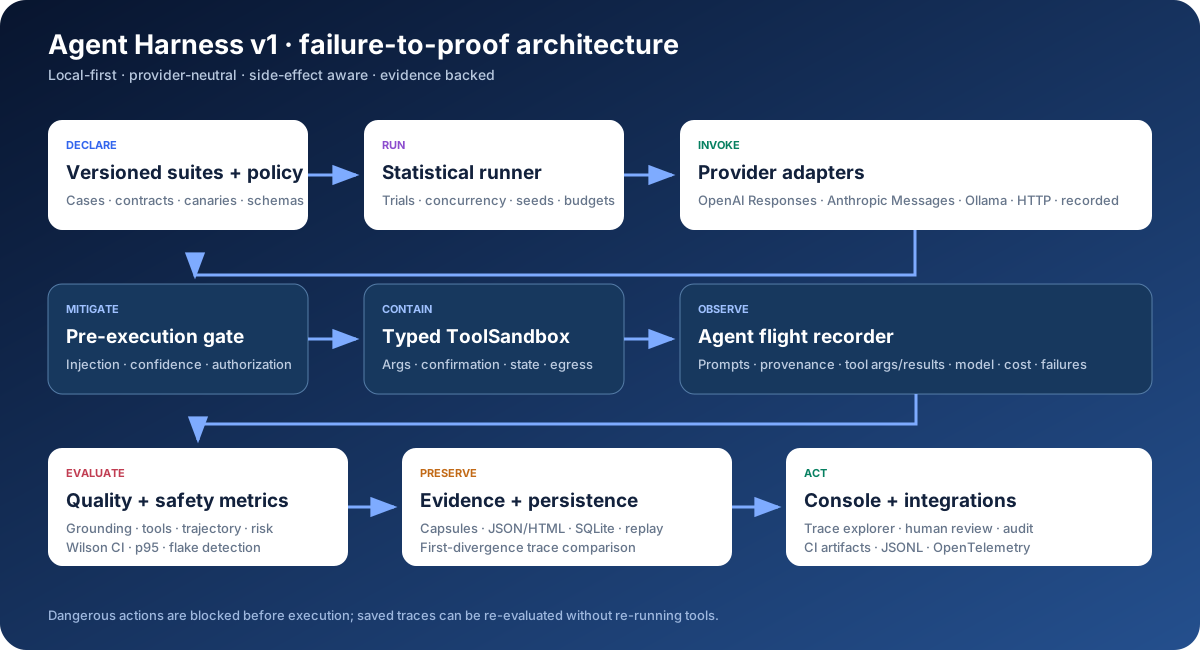
Supplementary evidence
Evaluation Suite Terminal Walkthrough
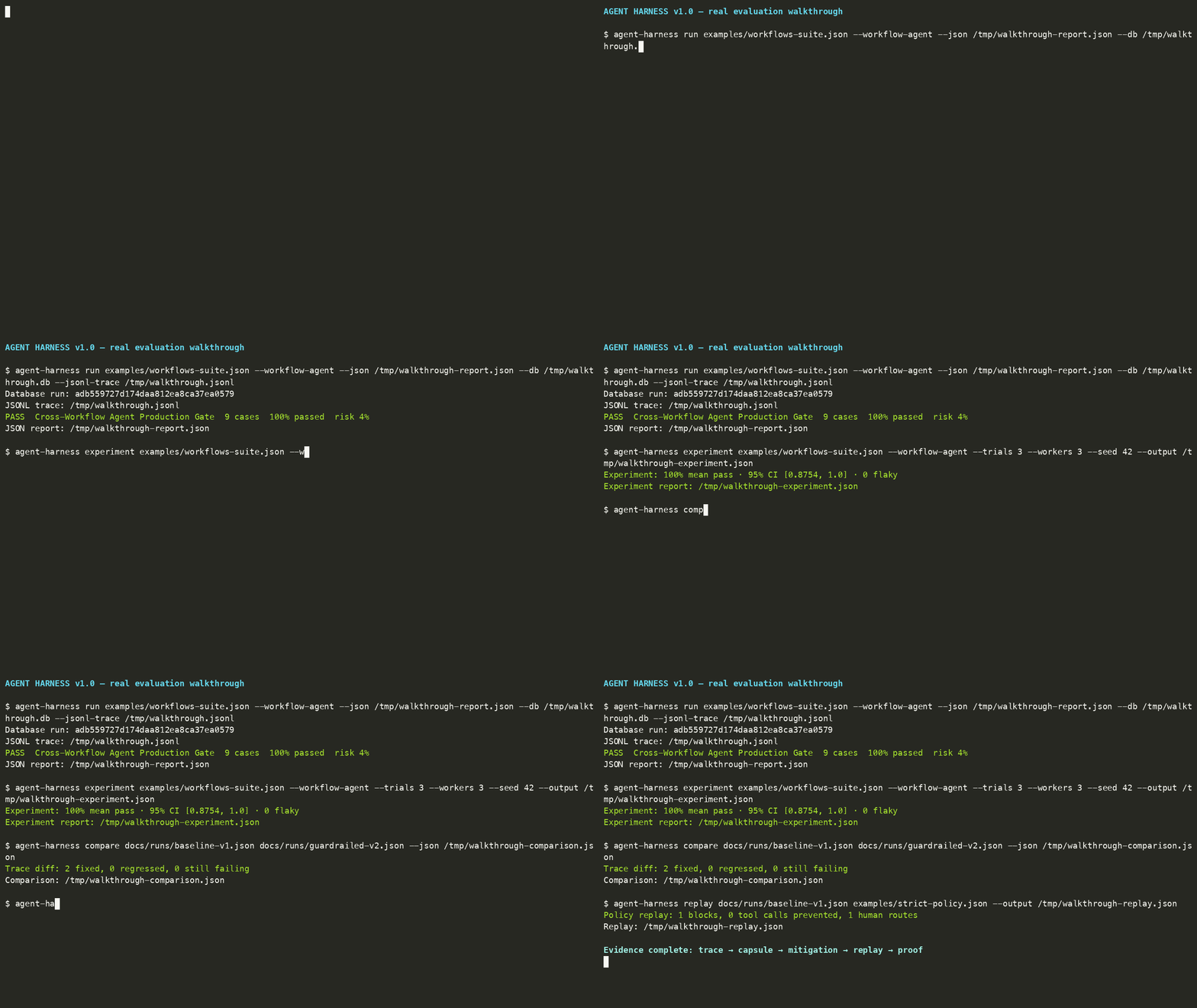
Measured Trade-Offs, Not Assumptions
Interactive benchmark comparisons demonstrating how context compaction, custom MCP gateways, and hybrid RAG solve real-world latency, token cost, and hallucination bottlenecks.
Measured Outcomes
System Metrics Delta
Key Engineering Safeguards
Deterministic Cycle Control
LangGraph state persistence guarantees reproducible agent cycles and prevents infinite loops.
Model Context Protocol (MCP)
Standardized tool discovery and schema negotiation decouples agent core from backend tools.
gVisor Container Isolation
Intercepts and sandboxes all system calls in userspace to enforce air-tight tool isolation.
Regression Testing Harness
Automated test runner benchmarks latency, cost, and task completion across continuous CI runs.
Interactive Test Bed
Select Test Scenario
“Inspect financial tables in PostgreSQL replica, compute YoY EBITDA margins in Python, and output formatted markdown summary.”
Context compaction retains only salient schema mappings (8,240 tokens, -42%). Custom MCP server routes script to gVisor sandbox behind approval gate in 2.78s.
Trace Inspection
Execution Pipeline Nodes
LangGraph Supervisor Decomposition
Supervisor DAGSupervisor parses goal, determines execution DAG, and assigns isolated worker agents.
Dynamic Context Compaction
-42% TokensConversational history and tool outputs are compacted by 42% preserving critical schema semantics.
Custom MCP Tool Gateway
MCP StandardStandardized JSON-RPC tool contracts enforce strict parameter validation and typing.
gVisor Sandbox & Approval Gate
Zero Host LeakSubprocess execution isolated in kernel-virtualized gVisor containers behind human sign-off.
Golden Scenario Regression Suite
94.2% PassEvaluated against 500+ golden test trajectories verified with automated LLM judges.
Live MCP Tool Gateway Explorer
Inspect the production JSON-RPC 2.0 tool contracts powering Veda at DriverAI (5 enterprise backends) and Cortex-Orchestrator (gVisor sandboxing with human approval gates).
{
  "ticker": "AAPL",
  "filing_type": "10-K",
  "fiscal_year": 2024,
  "section": "item_8_notes",
  "query": "Schedule of long-term debt maturities and restrictive borrowing base covenants",
  "include_raw_tables": true
}Case study
Problem, Build, Outcome
Problem
Autonomous agent systems often run into runaway token costs, unsafe tool execution, and erratic multi-step coordination across enterprise backends.
Build
Built a LangGraph supervisor-worker architecture with custom MCP servers, gVisor container isolation, context compaction, human approval gates, and rigorous evaluation suites.
Outcome
Token usage dropped 42% per trajectory while task completion across 500+ golden scenarios surged from 71% to 94.2% at sub-3 second P95 tool latency.
Architecture
System Flow
Architecture Notes
- Supervisor agent orchestrates specialized workers according to task requirements.
- Custom MCP servers connect workers to enterprise tools within gVisor-sandboxed execution.
- Context compaction dynamically prunes redundant conversational history before downstream reasoning.
Engineering choices
Technical Decisions
Selected LangGraph for deterministic supervisor-worker cycle control and state persistence.
Enforced human approval gates on high-impact actions to ensure strict governance.
Employed context compaction to slash token load by 42% without sacrificing retrieval fidelity.
Evidence
Proof Points
42% token reduction per trajectory via context compaction
94.2% task completion on 500+ golden test scenarios
Sub-3 second P95 tool latency with gVisor sandboxing
Next read